
Beneath the Bricks
A Hauntingly Good Walking Tour — Court Square, Charlottesville
Every city likes to tell you it was "always here." Charlottesville wasn't. Before any of it — before the courthouse, before the taverns, before the bricks under your feet were even laid — this ground belonged to the Monacan Nation, who raised earthen mounds here to honor their dead and held these hills as sacred long before anyone drew a county line through them. Everything this walking tour shows you, every stop, every story, sits on top of that first layer. That's the promise of Beneath the Bricks: we're not just walking a pretty square. We're reading it, layer by layer, down to the people standing under all of it.
For nearly three centuries, this handful of blocks was Charlottesville — courthouse, market, taverns, churches, all within a few hundred yards of each other. The Downtown Mall most visitors think of as "downtown" didn't exist yet. It grew outward from here, brick by brick, decade by decade. Which means the people who shaped this city didn't just pass through Court Square. They built it, worshipped in it, were bought and sold in it, fought to be remembered in it — and in more than one case, were deliberately buried under it.
Details
DATE COST LOCATION TIME FOOD and DRINK
Scheduled individually —
get in touch to reserve your preferred date and time.
$30 per Adult
$15 Youth 12-18
$10 Children Under 12
Senior Citizen #25
Charlottesville, VA
Court Square
Bring your own water.
No public restrooms on the route.
Scheduled individually —
get in touch to reserve your preferred date and time.


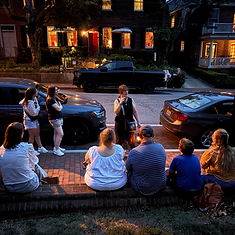

The People This Ground Remembers
This is an eleven-stop walk, and at nearly every stop, the history stops being abstract and becomes a person.
It becomes Jack Jouett, riding forty miles through pitch-black forest to warn a fleeing government the British intended to hang, not arrest — and Elizabeth Walker, buying him his head start with nothing more than food, drink, and unhurried hospitality that was really a quiet act of resistance. It becomes Maria Perkins, an enslaved woman whose actual handwritten words survive — "I write you a letter to let you know of my distress. My master has sold Albert to a trader" — written from a corner of this square where human beings were sold beside tobacco and livestock. It becomes John Henry James, whose 1898 lynching a few hundred yards from here waited 125 years for the state to even formally withdraw its indictment against him.
It becomes Uriah and Jefferson Levy, a Jewish father and nephew who spent a fortune and a lifetime saving Monticello from ruin — and were called "unpatriotic schemers" for it anyway. It becomes Moses Leterman, who wouldn't let a synagogue's history begin over on new brick, and had the old building carried here piece by piece so the mortar that held a century of prayer could hold the next one too. It becomes John West, a Black barber who watched a Klan parade pass his shop and knew exactly whose faces were under every hood — and chose, every single day, patience over vengeance, because patience was the only path left to build something better.
None of that is the kind of history you get from a plaque. It's the kind you get from sitting, for a moment, inside someone else's actual life.
Why This Deepens More Than Your History Knowledge
Most tours hand you dates and architecture. This one hands you people — and once you've met them, the square itself stops being scenery. You'll start noticing the difference between what got a hotel, a name, a permanent address in public memory, and what got buried under several feet of soil so no one would have to look at it. You'll leave with a far richer sense of who actually built this city: not just the men on pedestals, but the enslaved woman whose letter survived by chance, the immigrant family who held Mass in their own parlor for decades before they had a church, the barber who out-maneuvered an entire system without ever raising his voice. That's a deeper, truer inheritance than any single monument can give you — and once you've walked it, you carry it with you every time you cross this square again.
Reserve Your Spot
The ground remembers all of it — the harmony and the auction block, the rescue and the erasure, the bricks moved by hand and the statues removed bolt by bolt. None of it is finished. The only real question is whether you're listening. Are you listening?


